Helping People Live in Nature.
We furnish the legacy of log, timber, and structures.
Quality products, complemented with contractor referrals and DIY advice. www.loghelp.com 1-800-359-6614
What is the best way is to apply Shell-Guard RTU, diluted Shell-Guard Concentrate and/or solutions of Armor-Guard? Without a doubt the easiest and most effective way to apply any of these products is with a simple compressed air sprayer, a fancy way of referring to an inexpensive pump-up garden sprayer available at most Do-It-Yourself outlets for less than $20.00. Of course there are some available for a lot more money but they are really not needed for applying borate solutions. A basic pump-up garden sprayer works just fine.
What about using an airless sprayer? Airless sprayers put out a fine liquid mist. The droplet size is quite small and is easily carried away with even a slight breeze. In addition, the high surface area of the small droplets allows the water contained in the solution to rapidly evaporate leaving behind a high concentration of borate and mixed glycols. Rather than penetrate into the wood this combination forms a sticky film on the surface of the wood that takes a long time to dry. Not only does this negate the benefit imparted by a borate treatment but unless the sticky film is thoroughly washed off it will interfere with the adhesion of the finish. This can happen even if Shell-Guard RTU is applied with an airless sprayer. With solutions of Armor-Guard the loss of water results in a white coating of borate powder on the surface rather than penetrating into the wood and the white powder will show through our transparent finishes. In other words, don't use an airless sprayer for applying any of our borate preservatives.
For small jobs it's better to use a hand sprayer or a plant mister to apply borate solutions than it is to try and brush them on. Since the viscosity of the solutions is about the same as water it's just about impossible to apply any of them with a brush and not have them run down the wall.
Questions on maintaining the legacy of your wood structure? Give us a call- 1-800-359-6614
Pickup in store - or ship to your door -in whichever woods your cabin dwells.
Cobra Rods
are a safe, Environmental Protection Agency (EPA) approved wood decay
protection and prevention system for log homes. Cobra Rods are a wood
preservative, fungicide, and insecticide that's safe to handle and made
entirely of a unique Boron and Copper Hydroxide complex. Cobra Rods
include the addition of Copper Hydroxide which provides extended
protection from fungus species not affected by borates, effectively
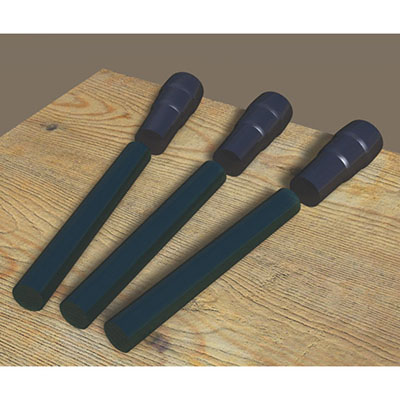
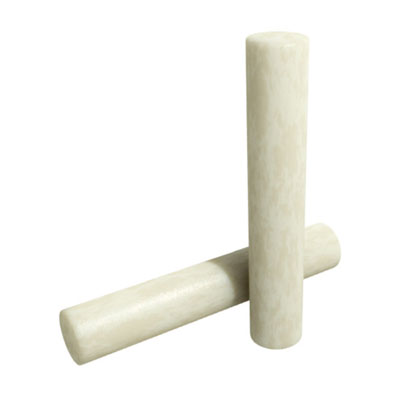
providing more protection then Impel Rods. Photo shows Cobra Rods and Cobra Rod Plugs.
Cobra Rods take the form of a solid cylindrical rod that is
approximately 7/16" in diameter (use a 1/2" drill bit for installation)
and comes in 2" and 4" lengths. Cobra Rods are a deep green color and
has a glass-like look and feel. When used for logs, the Cobra Rods can
be "plugged" with caulking or chinking to aesthetically hide them.
CobraRod Plugs are also available (included with the 2" 10 pack and 3"
12 pack of Cobra Rods). Cobra Rods can be used in logs, landscape
timbers, deck joists, posts, and other places where moisture is present.
The treatment cycle is 8 to 10 years if wood moisture is 20% or higher.
Cobra Rods are placed into holes drilled in wood at specific high risk
locations (such as at the groundline or near joints and exposed
endgrain) and are dependent upon moisture in the wood to work.
Cobra Rod Installation
The highest incidence of wood rot and decay happens at the ground line. The CobraRod targets this area and prevents fungal decay, termites, carpenter ants, various beetles and other wood-boring insects. This revolutionary combination of copper and boron is proven effective, safe and easy to use. North American utilities have trusted the CobraRod to extend the life of their wood poles. Now you too can benefit form this simple solution.
Bor8 Rods (previously known as Impel Rods) are a
highly effective preservative system for the prevention and control of
fungal decay (log rot) and many destructive insects in wood structures.
When moisture contents reach levels suitable for decay (i.e. around
25%), Bor8 Rods slowly dissolve and begin to diffuse throughout the
wood. Under 25%, the preservative becomes dormant.
Directions: Drill appropriate sized holes to
accommodate the predetermined number and size of Bor8 Rods required;
Insert the suitable size and number of Bor8 Rods into the holes; and
seal the hole with a treated wooded dowel, wood filler or caulk. Drill
holes 1/16" greater in diameter than the preservative rods to result in a
snug fit. This will ensure proper
diffusion in all directions from the rod. In addition, leave a minimum
of 1/8" of head space between Bor8 Rods and hole plug to allow for
expansion. After installation, paint or any other type of surface
coating may be applied to the wood if desired. Install Bor8 Rods in the
general vicinity of where the potential for decay is greatest or where
decay exists. Bor8 Rods can be inserted through any wood surface
depending on access, in either
a staggered, linear or angled pattern. Start at 1" from a joint or the
end of the wood and cover the entire affected length. Linear spacing
along the grain should not exceed 12" and spacing across the grain
should not exceed 3" on the center.
Questions on maintaining the legacy of your wood structure? Give us a call- 1-800-359-6614
Pickup in store - or ship to your door -in whichever woods your cabin dwells.
Armor-Guard
is a 100% powder borate wood preservative that you dissolve in water to
use. Armor-Guard protects uninfested wood from wood decay and wood
destroying insects. Like all borate treatments, your exterior wood
surfaces should be protected with a log home finish to seal in the
borates. Do not apply Armor-Guard over a stain or finish. Armor-Guard
stays near the surface and so should be reapplied if your log home
finish is physically or chemically removed. For a more penetrating
borate treatment for your log home see Shell-Guard RTU.
Remedial & Preventative Treatment: for remedial
control of organisms attacking wood, apply 10% aqueous solution of
Armor-Guard by brush or spay until surface is thoroughly wet
(approximately 5 gallons of solution per 1000 sq.ft.). Application may
also be made by drilling and then injecting the solution under pressure
into sound wood or until run-off is observed from entry/exit holes of
infested wood. * Alternatively, apply Armor-Guard powder to infested
members by drill and injection into galleries or dust generously on wood
surfaces and in wall voids at a rate of approximately 0.5 ounces (12-14
grams) per square foot.
Pre-Treatment: spray or powder/dust applications of
Armor-Guard may also be made to wood during construction. Apply solution
to all accessible surfaces of bare wood at a rate of approximately 5
gallons per 1000 sq.ft. Application should be performed after framing
and roofing are in place and before insulation and dry wall are
installed. Avoid spaying electrical components. Protect treated wood
from excessive rain. End-cuts of wood may also be treated by spray or
brush methods listed above, or by 5 minute dipping in Armor-Guard
treatment solution.
Armor-Guard Protects Against:
Ambrosia Beetles, Carpenter Ants, False Powder Post Beetles,
Furniture and Deathwatch Beetles, Longhorn Beetles, Old House Borers,
& Powder Post Beetles
Termites: Dampwood, Drywood, & Subterranean
Wood Decay Fungi
Features and Benefits
Can be used on all wood and wood composites
Provides a shell of protection around all treated wood
Will prevent and kill termites, carpenter ants, wood boring beetles and wood rot
Does not affect the color of wood
Does not interfere with the application of high quality wood finishes
Is easy to mix and apply and labeled for home owners to use
EPA approved
Application Temperature: 40° to 90° F. Coverage: Approximately 200 sq. ft. per gal. of mixed solution. A 17 lb. pail covers approximately 3,400 sq. ft. Coats: 1 coat application. Mix 1 pound (4 cups or 2 of the enclosed scoops) of powder with one gallon of water. Surface Prep: Must be clean dry bare wood. Do not apply over a finish. Drying Time: 1-3 days. Clean up: Soap and Water Shelf Life:
5 years; the stability of Armor-Guard in a liquid solution has a
limited life cycle. This is why we recommend to mix up only what you're
going to use and store the powder for later.
Questions on maintaining the legacy of your wood structure? Give us a call- 1-800-359-6614
Schroeder Log Home Supply, Inc.
1101 SE 7th Avenue
Grand Rapids MN 55744
Cobra Rods
are a safe, Environmental Protection Agency (EPA) approved wood decay
protection and prevention system for log homes. Cobra Rods are a wood
preservative, fungicide, and insecticide that's safe to handle and made
entirely of a unique Boron and Copper Hydroxide complex. Cobra Rods
include the addition of Copper Hydroxide which provides extended
protection from fungus species not affected by borates, effectively
providing more protection then Impel Rods.
Cobra Rods take the form of a solid cylindrical rod that is
approximately 7/16" in diameter (use a 1/2" drill bit for installation)
and comes in 2" and 4" lengths. Cobra Rods are a deep green color and
has a glass-like look and feel. When used for logs, the Cobra Rods can
be "plugged" with caulking or chinking to aesthetically hide them.
CobraRod Plugs are also available (included with the 2" 10 pack and 3"
12 pack of Cobra Rods). Cobra Rods can be used in logs, landscape
timbers, deck joists, posts, and other places where moisture is present.
The treatment cycle is 8 to 10 years if wood moisture is 20% or higher.
Cobra Rods are placed into holes drilled in wood at specific high risk
locations (such as at the groundline or near joints and exposed
endgrain) and are dependent upon moisture in the wood to work.
Made in Canada.
Wood ends and joints are particularly susceptible to fungal attack and an appropriate size rod should be inserted within 3 inches of any end or joint in high-risk areas.
Linear spacing along the grain should never exceed 15 inches on center and spacing across the grain should
not exceed 6 inches on center. After the rods are in place, the holes should be plugged using a plastic plug,
wooden dowel, caulk, chinking or wood putty. The treated area can be painted, stained, or coated with any appropriate finish.
Application Steps
Drill appropriate size holes to accommodate the number and size of CobraRods required. Drill hole
size should be approximately 1/16” larger than rod size. Plug size should be approximately 1/16”
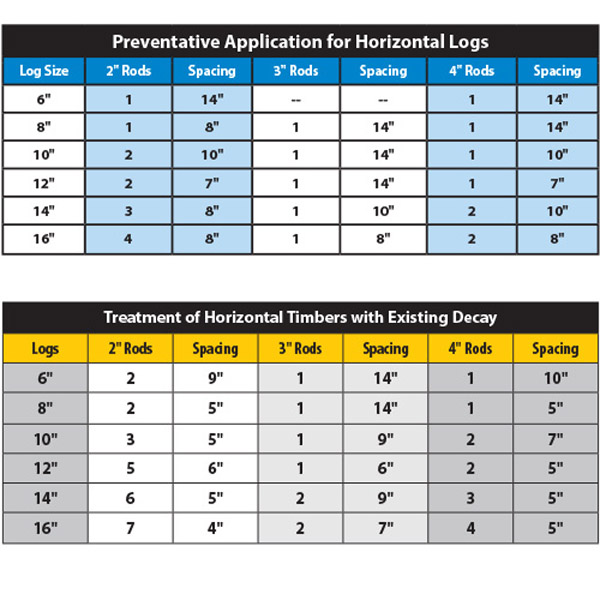
larger than hole size. (Consult the recommended Application Rate Table for this information).
Insert the CobraRods into the hole or holes.
Plug the hole with a plastic plug, wooden dowel, caulk or wood putty.
Questions on maintaining the legacy of your wood structure? Give us a call- 1-800-359-6614
Schroeder Log Home Supply, Inc.
1101 SE 7th Avenue
Grand Rapids MN 55744
Rot, weather, insects, fungi all pose a serious threat
to your logs. Protect your investment—treat your logs
first to make them last.
All wood faces the possibility of rot and insect infestation—even in dry climates. Fungi and insects actually
consume the cells of dead wood, often causing severe
structural damage, damage that often requires log
replacement—a costly repair.
Tim-bor® helps protect your home from the costly
damage caused by rot and insect infestation.
What is Tim-bor® ?
Tim-bor® is a borate-based wood preservative.
Borates are well-known across the world for their
protective qualities. And like other borates, Tim-bor®
is highly effective in the prevention of most rot and
wood-boring insects.
When using Tim-bor®, a protective “shell” coating
helps defend your home against dry, wet, and brown rot
as well as termites, house borers, powderpost beetles
and carpenter ants (to name a few).
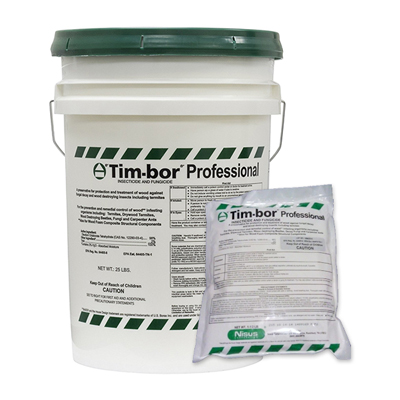
Tim-bor Professional Borate in 6 gallon and 1.5 pound
The Tim-bor® Difference
Tim-bor® is registered with the Environmental
Protection Agency (EPA) for spray and brush application, which makes it perfect for remedial treatment
when you follow all application and use guidelines.
Do not mix Tim-bor® into stains. For borates to be
effective and to provide long-term protection, they must
soak into the wood itself, not remain in the coating.
Although some stains contain borates, the low percent-
age of borate in the stain (generally 2-3%) provides lit-
tle to no appreciable benefit. Follow the Tim-bor® mix-
ing and application guidelines to achieve recommended
BAE (borate acid equivalent) levels that truly provide
long-term, effective protection.
Tim-bor® can be applied by brushing, spraying,
dipping, kerf-flooding or hole flooding. It comes in
powder form and just needs to be mixed with water for
application. Tim-bor® is packaged in two convenient
sizes: 6-gallon pails that are easy to carry and double as
a handy source for mixing the solution and the 1.5 lb.
packet—perfect for smaller jobs.
The active ingredient in Tim-bor® (disodium octaborate tetrahydrate, a refined form of the natural mineral
borax) is less toxic to people and animals than many
other chemicals used for wood preservation. However,
since no pesticide is completely safe, Tim-bor® must be
handled and used as directed. Borates do not affect the
natural color or strength of wood they are completely
odorless they’re not corrosive to metal fasteners, nails
or screws. And when a “Tim-bor® home” is properly
sealed against moisture, the borates can provide many
years of effective protection.
More Protection for Your Money
The best part about Tim-bor® is the money it saves
you. Not only is Tim-bor® affordable, it reduces the
risk of potential log replacement.
According to the most comprehensive study avail-
able, the depth of penetration of Tim-bor® is as deep or
deeper than other borate products that use slow-drying
and toxic solvents (like ethylene glycol) in their formulations. Contact Sashco at 1-800-767-5656 if you’d like
a copy of this study.
The Basics in Applying Tim-bor®
1. Read this entire Data Tec and the container label
before applying Tim-bor®. It is a violation of Federal
law to use this product in a manner inconsistent with
its labeling.
2. Mix Tim-bor® at a rate of 1-pound (1 loosely packed
quart) to 1-gallon of water.
3. Wood must be clean and bare; free of dirt, wax, mill
glaze and surface finishes, and wood surface temperature above 40̊F.
4. Apply Tim-bor® at the rate of 1 mixed gallon per 150
ft2 of wood surface. Apply a second coat 4 to 24 hours
later. Thoroughly soak cut ends, checks and cracks.
5. Coat the logs with a water-repellent finish after the
Tim-bor® solution has thoroughly dried. Use a moisture meter to verify that the log’s moisture content
doesn’t exceed 19%.
Where to Use Tim-bor®
Use Tim-bor® on above-ground wood surfaces,
including logs, timbers, dimensional lumber, siding, etc.
Wood subject to direct moisture contact must be coated
with a good water-repellent finish after treating with
Tim-bor®.
Surface Preparation
Wood surface must be bare: free of dirt, wax, mill
glaze and surface finishes. Remove all previous coat-
ings by media blasting, sanding, chemical stripping and/
or power washing. Surface discoloration from mold
or mildew should be treated with Sashco’s CPR® Log
Cleaner & Brightener before applying Timbor®. Read
“Keeping the Dream Alive,” Sashco’s complete staining guide, for more detailed instructions on this and the
finishing process.
Do not apply to frozen wood. Log (not air) temperature must be between 40̊F and 90̊F. It is best to apply
Tim-bor® to dry wood.
Mixing Tim-bor®
Mix at the rate of one pound, or loosely packed quart,
to one gallon of water. The Tim-bor® mixture requires
only mild stirring before application. The mixture will
be clear and water thin.
With this mixture, all application methods described
herein will yield a minimum retention level of 0.24
pounds per cubic foot boric acid equivalent to 1/2”.
Methods of Application
Tim-bor® may be applied by brushing, spraying
(with a garden sprayer), dipping, kerf-flooding or hole
flooding. Full immersion dipping yields the deepest and
most complete protection, especially with large logs.
Kerf-flooding accompanied with brushing or spraying,
yields nearly the same level of protection as dipping.
Brushing and spraying can completely penetrate dimensional lumber and can provide excellent “shell” protection for timbers and logs to a depth of 1/8” to 1/2” —
which is adequate for most applications.
NOTE: Diffusion of Tim-bor® into the wood begins
immediately and requires several days for completion.
With “shell” protection in large logs or timber, pre-existing insect larva may not be killed. Upon maturing,
they may emerge from the wood. Insects must ingest
the substance to be killed. Tim-bor® is not a contact
killer. Further insect infestations, however, will be prevented.
Brushing or Spraying
Apply Tim-bor® at a rate of 1 mixed gallon per 150
ft2 of wood surface. Apply a second coat 4 to 24 hours
later. Thoroughly soak cut ends and apply to checks and
cracks.
Kerf-Flooding,
Hole Flooding,
and Spraying/
Brushing
Logs 9” in diameter
and larger are often kerfed to control unwanted
checking. When kerfing
a log in the shape of a trough (with 3/8” wide chain saw
to a depth of 3”), simply pour the Tim-bor® solution
into the kerf. Fill the kerf at a rate of 15 to 20 lineal feet
per mixed gallon. Let soak. It will take 1 to 2 days for
the logs to absorb all the liquid.
Protection may also be
gained by pouring powdered
Tim-bor® into the kerf (0.2
to 0.3 pounds per lineal foot).
Pour water into the kerf to
dissolve and carry the Tim-bor® into the wood.
Brush or spray the exterior
of the logs with more Tim-bor® after either of these
methods as described above.
NOTE: Be sure the kerf or
holes do not affect the structural strength of the log.
HINT: Runoff from vertical walls may be contained
by using plastic sheeting to form an accumulation
basin. The trapped liquid may then be recycled and will
be prevented from injuring nearby foliage.
Dipping
Dip logs or lumber in Tim-bor® for 6 to 10 minutes, depending on log diameter. Let excess liquid
drain back into the tank, dip again 24 hours later. Cover
wood with a tarp or place in a shed for at least 48 hours
prior to coating with a good exterior finish.
After Applying Tim-bor®
Treated wood must be protected from direct contact
with moisture or the active ingredient may leach out.
It’s best to wait at least 48 hours (in warm, dry weather;
longer in cool, humid weather) after applying Tim-bor®
to coat wood with a water-repellent finish. Let the surface thoroughly dry and brush away any crystals that
appear before staining. Use a moisture meter to verify
that the logs’ moisture content doesn’t exceed 19%.
Clean Up
Use soap and water to clean equipment, skin and
clothing.
Please download the Tim-bor®
full info sheet for details on:
• Storage and Disposal
• First Aid
• Enviromental Hazards
• Warranty
www.sashco.com/timbor-sds-info
Questions on maintaining the legacy of your wood structure? Give us a call- 1-800-359-6614
Schroeder Log Home Supply, Inc.
1101 SE 7th Avenue
Grand Rapids MN 55744
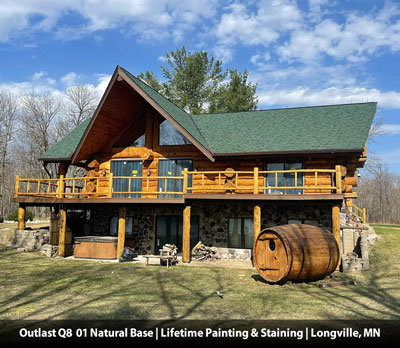
Outlast™ Q8 Log Oil is an EPA registered exterior wood preservative specifically designed to control decay causing organisms (and mold, termites, powder post beetles) in log homes and on wood siding. Outlast Q8 Log Oil provides unsurpassed water repellency and sheer trans-oxide color with one coat coverage. Outlast Q8 Log Oil is a totally non-film forming exterior treatment that will never crack or peel. The trans-oxide pigment system provides excellent UV control that operates like a sunscreen to slow down graying of the wood and provide fade resistant color. The solution soaks into the wood to provide protection, not just on the surface, but also deep into the wood cell structure. Outlast Q8 Log Oil offers unique flexibility in terms of application temperature ranges, log moisture content, and delivery method. Outlast Q8 Log Oil meets all nationwide VOC requirements.
Made in the USA.
Stops decay fungi and mold - Rot control, Toxic to termites and powder post beetles
Superior water repellency - Controls cracking and splitting
Easy to apply - One coat coverage - low pressure spray, brush, or roll - low-pressure spray application to refusal
No lap marks or brush marks - Simple re-coat: no stripping required
No cob blasting, sanding, or sandblasting needed for re-coats.
Stocked and available online or local pickup in our store:
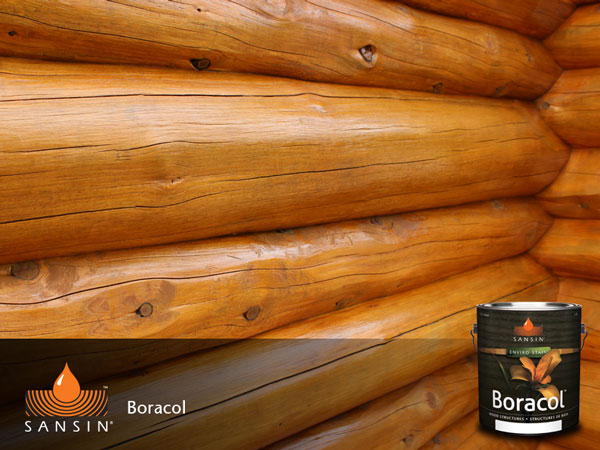
Wood is an incredibly strong building material, but it must be protected properly to stand the test of time, and that means protecting it against wood-destroying fungi, insects and mold. Sansin Boracol 20-2 is designed to do just that - fight fungi and insect infestation. It is recommended for use on roof, floor or structural timbers, joinery, joist ends, and door and window framing. Boracol 20-2 penetrates wood exceptionally well – even heartwood, up to 3-5mm deep. It establishes a reserve from where further penetration takes place (up to 40 mm over two years in dry wood).
Because Boracol diffuses with moisture, it migrates into areas with higher moisture content. Boracol can also be used to eradicate wood rot in existing structures, and it can also be used to protect new and existing logs and timbers against fungi and wood-boring insect. In addition to organic surfaces such as wood, Boracol works to prevent mold on inorganic materials like stone or concrete. Sansin Boracol contains boron, which is far less hazardous than traditional treatments and will give your project the lasting protection it needs – with low toxicity.
The Science Behind Boracol
Premature decay of untreated wood that was periodically or permanently exposed to increased moisture content (over 25%) reached serious proportions in North America in the mid-2000s. As a result, requirements for reliable treatments were introduced. Boron-based wood preservatives were found to be the most acceptable pre- and remedial treatment for rot and insect attack.
In addition to their proven efficiency, the borate formulations are widely accepted as environmentally safe wood preservatives, having very low toxicity. Boracol wood preservatives are based on inorganic Boron (disodium octaborate tetrahydrate), which not only has the ability to diffuse in moist wood but also contains a very low vapor pressure and has the ability to progressively penetrate the wood even several years after application. Over this time, because of the boron concentration in the wood, the degrading organisms have no chance to survive and cause damage.
The only condition for proper performance is that the treated wood should not be exposed to direct contact with water (i.e. wood-in-ground contact or occasional heavy rain over construction wood). If the wood is exposed to water in this way, it is possible the Boron will “travel the opposite way” by a leaching process. To keep this from happening, a post-treatment application of the wood surfaces is recommended by applying a proven wood protection system like Sansin SDF, DEC or Classic 1-2-3.
How to Apply Boracol
Boracol can be applied by brushing, dipping or spraying. Within the first 24 to 48 hours, the product will penetrate 3-5 mm deep into the wood and will establish a reserve of over-concentrated Boron from which further penetration and diffusion will take place depending on the wood’s moisture content.
Brush Application: This method requires some shear force to be applied in order to evenly spread the product over a range of different surface profiles. The brushing method yields best results if applied before wood components are assembled.
Dipping: This method requires a non-corrosive dipping tank and an additional support surface inclined at an angle to allow excess product to drain off into the tank. The advantage of this method is that all the surfaces – including splits and cracks – are fully treated.
Spraying:Different spray applicators can be used, and the viscosity of the product can be adapted by adding up to 5% water.
Injection Method: This method is used to increase the quantity of Boron in wood locations where condensed water may be trapped for a longer period. A syringe-type injector can be used to fill cracks and gaps or pre-drilled holes.
It is advised to clean the wood before treatment. Vacuum cleaning, power washing or compressed air are good ways to remove dirt. Boracol forms a wet-appearing film on wood surfaces as soon as the product is applied. The film will stay on wood for a period necessary for the solvent to penetrate the wood surface, bringing the Boron compound deeper in the wood. During this time, the treated wood surfaces should be protected from contact with water.
If the treated wood is intended for subsequent paint or stain application, allow at least seven days for Boracol to completely penetrate and disappear from the surface. If a slight film or crystal-like particles are visible, the surface should be wiped off with a damp cloth. Light sanding can be very helpful to remove boron crystals and improve adhesion of the coating. Subsequent coating is particularly important when wood is exposed to contact with rain or con-densed water that stays trapped in the wood for a longer period of time (e.g. balconies). To learn more about Sansin Boracol 20-2, click here.
Borate (disodium octoborate tetrahydrate)is a common solution to preventing or
stopping fungal rot in wood, as well as
insect infestation. Borates come in several forms: powder, which is added to
water for application; liquid, which is carried in glycol; and concentrated
rods, two brands of which are CobraRod and Bor8 Rods.
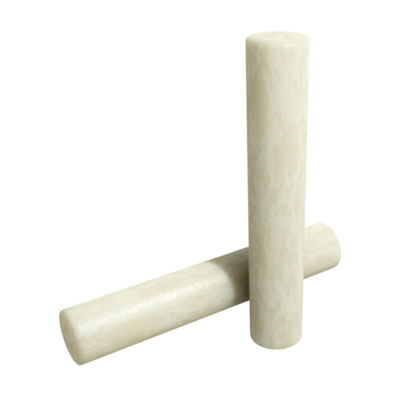
CobraRod and Bor8 Rods(formerly known as Impel Rods) are
similar products in form and function. They are both dowels composed of
concentrated, compacted borate preservative. They are applied to logs and
timbers by drilling a hole to size, inserting the rod, and plugging the hole
with caulk, wooden dowels, or wooden or plastic plugs. They both sit dormant in
the wood, unless the moisture content of the wood reaches a point where rot
becomes a risk. At that time, the rods slowly dissolve into the wood and
prevent rot from happening. So, in terms of what they are and how they work,
CobraRod vs Bor8 Rods are two similar products (e.g. Pepsi vs Coke, Chevy vs
Ford).
How are they different? There are three primary differences
between the two brands: preservative, packaging, and point of activation.
Bor8 Rods
Preservative: Both
CobraRod and Bor8Rods have an active borate ingredient registered with the EPA
as a preservative. CobraRod has an additional copper preservative, which takes
care of some fungi unaffected by borate. The copper also gives CobraRod a dark green color, whereas Bor8 Rods remain looking borate-white.
Packaging: Though
it is just a matter of marketing and not performance, there are some
differences in the sizes and quantity packaging available between the rods. A
minor detail, but if a certain size or smaller quantity is needed then one
choice may be better than another. For smaller wood applications like window and door frames, Bor8 Rods offer 1/4"x1/2" rods for minimal treatment areas.
Point of Activation:
Bor8 Rods begin to dissolve and diffuse into the wood around 25% moisture
content. CobraRod activates at around 20% moisture content.
Either rod can be used preventatively or remedially, but it
is good insurance to apply them preventatively to lower or exposed logs that
may see moisture for constant duration. Logs sitting at deck level, log
ends jutting past protection from eaves, and sill prone to collecting rain or
snow are all good places to consider inserting preventative borate protection
through these rods.
Give us a call at 1-800-359-6614 or visit our website if you have any other
questions about using rods for rot prevention.